

release date May 5, 2026
The Beehive
I don’t remember which of us found it.
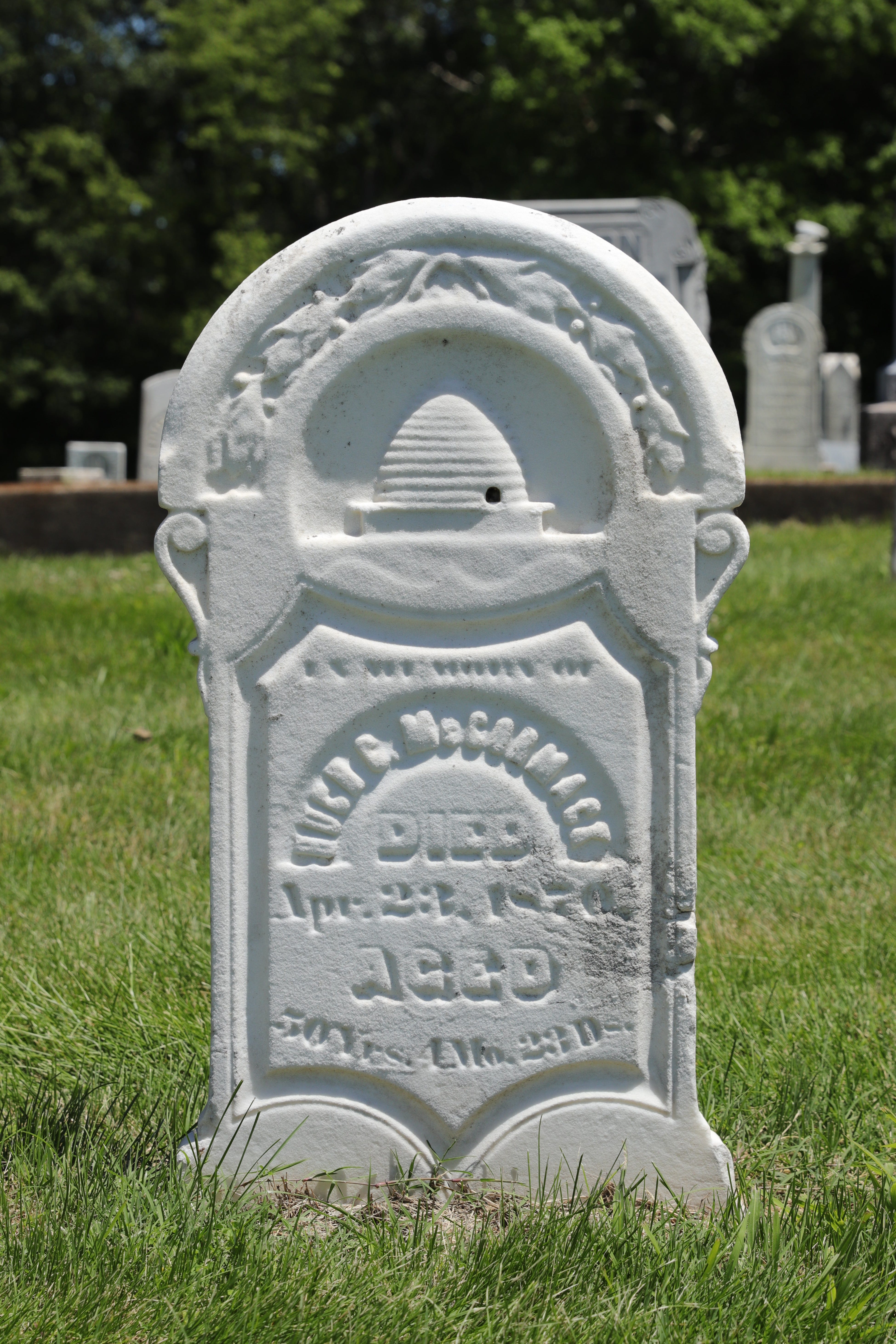
Carole1 and I began work on gravestone restoration at Union Cemetery in 2019. Many of the markers were thick with mold, black and illegible. We lightly cleaned with biocide, hoping for instant gratification. The first treatment was applied in 2020 and four years later it was finally ready for its documentation photo.2 This shot was taken on May 29, 2024. Time is an essential ingredient.
To our delight, there it was, a beehive.
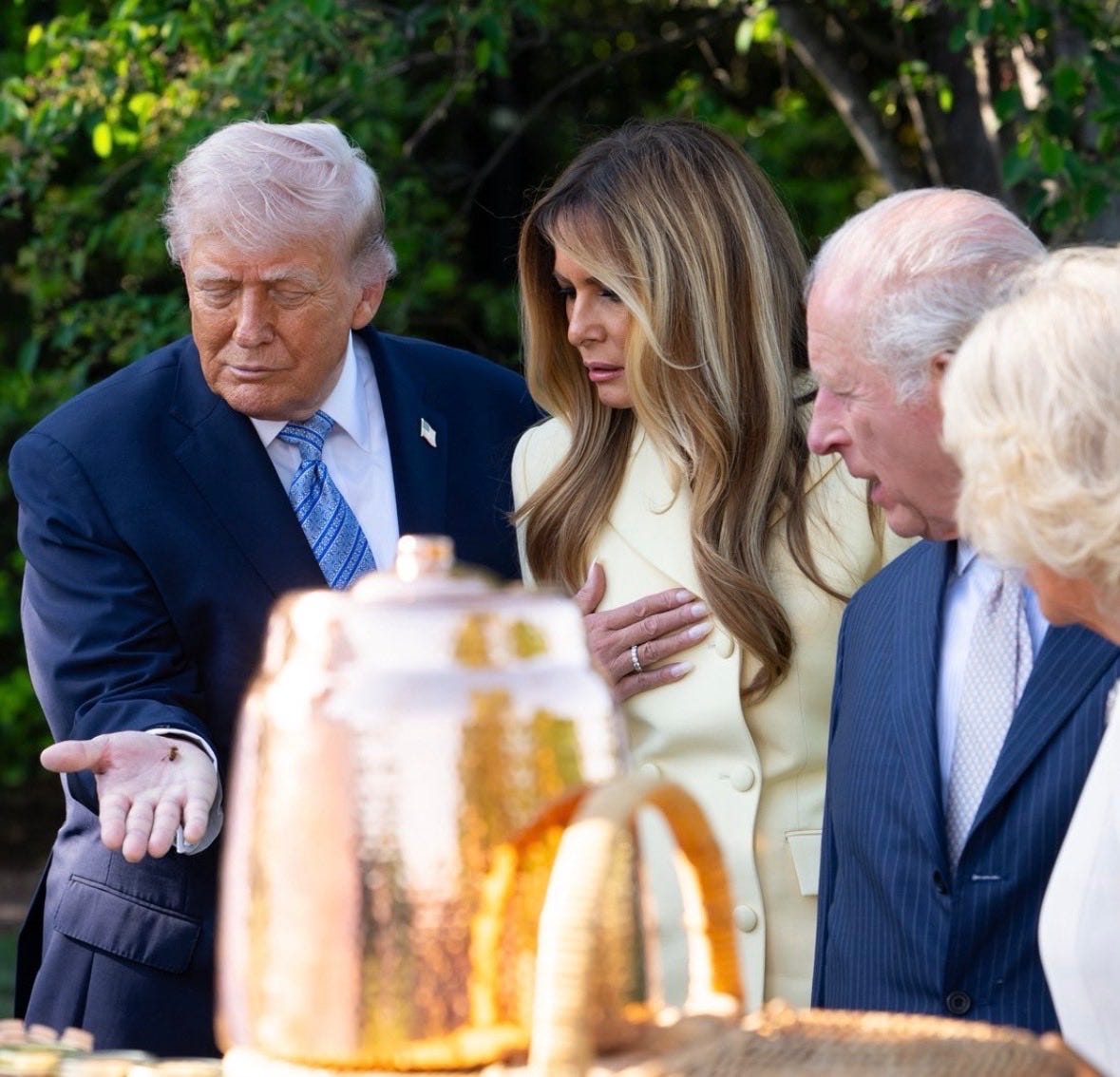
This past week a bee landed harmlessly on President Trump’s hand as he and First Lady Melania were showing the new White House beehive to Charles and Camilla on their recent state visit. Keyboard warriors did not disappoint with immediate speculation as to the significance of this message from the natural world.
In European and particularly British history, “telling the bees” is a ritual to perform whenever there is change in the power dynamic. It is especially important to the succession of monarchs. Telling the bees of a visit from the King of England is wholly consistent with this tradition.
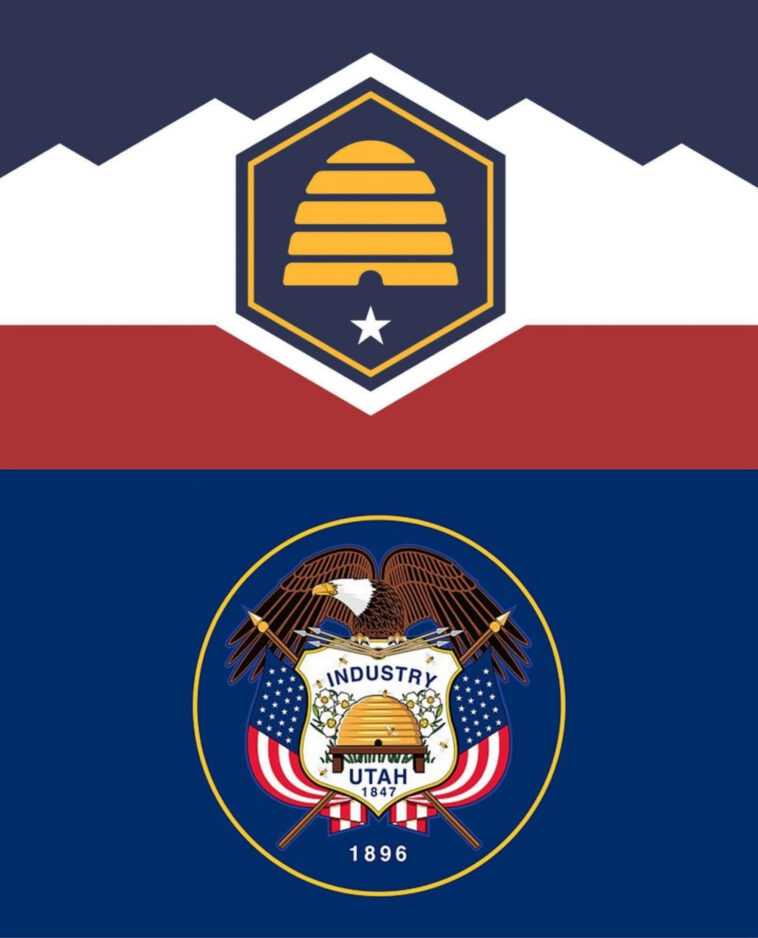
The beehive is not a common symbol found on grave markers but neither is it extremely rare. Notable examples of beehive symbols on grave stones include Adam Grimm, the father of American beekeeping. He imported docile Italian bees which interbred with wild American bees to create the common honeybee found today in North America. Mormons purchased hundreds of bee colonies from Grimm. The beehive found on the Utah state flag is undoubtedly an Adam Grimm beehive.
There is also the case of William Lossing. He was a notable beekeeper, as well as Presbyterian and Mason who died in 1918 while loading two cars full of honey.
Here is the problem. Any exploration of its meaning leads everywhere. The following are all attributed to the beehive symbol.
Christian
member International Order of Odd Fellows
Mason
member of the Rochdale Society of Equitable Pioneers (an early British buyers co-op circa 1844)
industrious
bee keeper
cooperative community
The Hidden Hand
There is also a darker meaning. To some the beehive represents a secret elite or “hidden hand” working collectively for society’s benefit, sometimes through covert influence, political maneuvering, or extra-legal means. There is no better example than the 2024 movie, The Beekeeper starring Jason Statham. If you like the thriller revenge genre with extra helpings of gratuitous violence, I heartily recommend. If exploding buildings and fingers removed with a bandsaw are not to your liking, consider a pass. You have been warned.
What do we know of Hugh Coffey McCormack?
He was born in Tennessee in 1819 four miles west of Fayetteville and trained early as a blacksmith. His father died at age eight, and then in 1839 at age 20, moved to Randolph County, Illinois with several of his brothers. His mother and younger siblings followed four years later after the farm was sold. His mother’s brother Hugh Coffey Gault was already in Randolph county, a merchant and known operator of the underground railroad in the village of Eden.
Eden was considered by pro-slavery adherents as a “nest of harping abolitionists.” Mere residence was certain identification as not only an abolitionist but an active member of the slave stealing underground railroad.
Hugh Coffey McCormack, known as “Coffey,” operated a black smith shop in Sparta with his younger brother, John. His other brother Mathew Stone McCormack was also a blacksmith (in nearby Chester) as well as a member of Masonic Lodge 162 in Sparta, Illinois. His mother, Susannah Gault McCormack is an original “daughter” as in Daughters of the American Revolution.


In the 1850 census Coffey is shown as a blacksmith in Sparta with real estate holdings of $200. By 1859 he is named assessor for his town3 and by 1860 his real estate holdings are valued at $1,800, a nine fold increase. The blacksmith business is physically and mentally demanding but also quite lucrative. It is also the center of the community. Every farmer and every horse owner, sooner or later must visit. Plows need sharpened and horses need shoes.
About that same time his brother Mathew Stone McCormack diversified into other ventures including the saloon business. Mathew would later become a significant member of the local Democrat party.
Coffey seems to have had a falling out with his brother, Matthew. It came to a head in 1860 as they faced each other in the race for county sheriff, Coffey as Republican, Mathew a Democrat. Coffey lost to his brother in the same election that catapulted Abraham Lincoln into the White House.
I could find no evidence that the election was contested but cheating was common in Chester where Missouri residents were known to illegally vote.4 Randolph County was still pro-slavery by a narrow margin.
When the war broke out Coffey enlisted in the Union Army Company I of the 22nd Illinois Infantry, age 38, June 25, 1861 as a blacksmith for a 3-year term of service. His rise in rank was meteoric. He moved from private to 1st lieutenant in eleven months, an almost unheard of career progression.
He was first promoted to Quarter Master Sergeant and then after 6 months to 2nd Lieutenant on Dec 14, 1861. Immediately after the bloodbath of Shiloh in early April, he was again promoted, this time to 1st Lieutenant on May 11, 1862. Perhaps because he had seen enough carnage or because of the intense demand to replace the 13,000 Union casualties at Shiloh, Coffey resigned June 28, 1862 and returned to Sparta commissioned as a recruiting officer.5 He died on April 23, 1870 at age 50 of pneumonia and was buried in Union Cemetery.
There is also no doubt that Hugh Coffey McCormack’s 1st cousin, Hugh Coffey Gault was a member of the local underground railroad. He is identified as such by personal interviews of numerous people after the Civil War.6 Gault in the 1850 census is identified as a merchant operating in Eden, the center of underground railroad operations in Randolph County.
Was Coffey also a clandestine member of the underground railroad?
The operator of a blacksmith shop was perhaps the best social networking position in Sparta. It was ideal to make connections on freight wagons, supply transportation or provide other discrete aid to runaway slaves.
There is also the fact that Coffey was financially well off. The overwhelming majority of other underground railroad operators were above average in achievement and financially secure.
He was quick to enlist as a volunteer early in the war. Many of the earliest Union army officers were from known underground railroad families. Not only that but he joined the army at age 38, in spite of a business to run and a young family to raise. He was a true believer in the Union cause.
Hugh Coffey McCormack ran for Sheriff as a Republican in 1860. This alone is a strong indication of his intent. The power of a county sheriff is immense.7 He can literally decide which laws are enforced and for the Randolph County underground railroad, this by far would have been the most important political position to control.
When compared with other known operators on the underground railroad Coffey fit the profile in every way. But inference is not proof. A more likely scenario is that he worked behind the scenes supplying information, money and resources while preferring to keep discretely quiet and let others do the dangerous “night runs.”
Ultimately, we may never know his exact connection to the Underground Railroad, but we do know he was an important member of his community. He ran a successful trade, fulfilled his military service, raised a family and still had energy to take care of his community in the way that he was inspired to do so.
If you are lucky enough to find a beehive symbol while wandering through an old cemetery take a moment to pay respect. For you are standing next to a man among men, the sort that quietly guides his community and keeps the world from spinning off its axis.
copyright 2026 David D. Shaw
Carole Morris Pancake, a fourth cousin, retired librarian, brilliant genealogist and frequent collaborator on cemetery research.
We jokingly refer to the professional quality documentation photo as “the prom picture.”
J. L. McDonough & Co. 1883. Combined History of Randolph, Monroe and Perry Counties, Illinois: With Illustrations Descriptive of Their Scenery and Biographical Sketches of Some of Their Prominent Men and Pioneers. Philadelphia: J. L. McDonough & Co.
David D. Shaw, “Ballots and Blood Feud: The 1847 Randolph County War,” Serengenity (blog), March 26, 2026, https://serengenity.substack.com/p/ballots-and-blood-feud-the-1847.
“Sparta, Randolph, Illinois, United States Records,” images, FamilySearch (https://www.familysearch.org/ark:/61903/3:1:3Q9M-CS3D-R37X-5?view=explore : accessed May 3, 2026), image 998 of 2064; Image Group Number 007832501.
Wilbur Henry Siebert, The Underground Railroad from Slavery to Freedom (New York: The Macmillan Company, 1898)
In 1860 Illinois, the county sheriff was an elected constitutional officer with sweeping de facto power as the chief law enforcement authority, operating with significant independence from state control. That same structural autonomy persists today, allowing modern Illinois sheriffs—still elected and serving as the top law enforcement officer in their county—to exercise broad discretion in prioritizing which laws they aggressively enforce. This independence was exercised in 2023 when 98% of gun owners and 90% of Illinois county sheriffs publicly refused to enforce or follow Governor Pritzker’s 2023 assault weapons registration requirement. The law was obviously unconstitutional as well as so poorly written that it constituted a grave and immediate threat to public safety. The independence of the county sheriff is an important part of Constitutional checks and balances.
This is a really interesting article
I’m currently noodling on a “telling the bees” piece, so the bee landing on Trumps hand the other day set my mind to fancy, as well. Living in this part of WY, we are surrounded by beehive iconography with the heavy presence of the LDS. I should check the cemeteries…